| Home | : | Biography | : | Fellowships & Awards | : | Publications | : | : | Mediation | : | Useful Links | : | Contact |
 The condition is generally managed by Rheumatologists. It is usual that they make the diagnosis and treat the condition with specific anti-rheumatoid drugs. Splints may also be employed. Referral to a hand surgeon can be for various reasons.
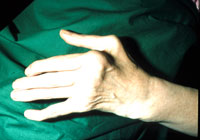
Joint Deformity This occurs quite commonly in rheumatoid arthritis, particularly the metacarpophalangeal joints where the fingers tend to drift towards the little finger side of the hand. The picture below illustrates the drifting of the fingers towards the little finger side of the hand.
This is called ulnar drift. Occasionally, if this is associated with pain in the metacarpophalangeal joint, this drift can be corrected by means of joint replacement in the hand, particularly the metacarpophalangeal joint.
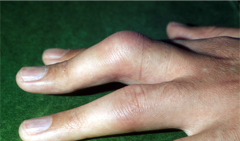
The second deformity is the Swan Neck deformity where there is an over straightening of the proximal interphalangeal joint, a bending of the distal interphalangeal joint which makes the finger look a little bit like a swan neck. This can be helped with tendon transfer surgery.
Joint Instability Quite often joints of the fingers or thumb can become unstable in late rheumatoid which means they become floppy and for instance, pinch can be tricky if the end joint of the thumb becomes floppy. This can be treated by fusion in order to stabilise the thumb which is a very successful surgical procedure for such a deformity. Pain Various joints in the wrist and the hand can be helped if they become very painful.
|

|