




| Home | : | Biography | : | Fellowships & Awards | : | Publications | : | : | Mediation | : | Useful Links | : | Contact |
|
Scaphoid fixation The scaphoid bone is a bone on the wrist on the thumb side that is in the shape of a boat. It unfortunately has an odd blood supply in the fact that when it is broken it quite commonly doesn't heal (10-20%). It is normally treated by plaster immobilisation for three months. If the fracture is acute, i.e. has happened within two weeks it is feasible to fix the fracture with a screw and this would prevent the three months of plaster immobilisation. This is done by taking a little bit of bone from your hip and placing it into the gap between the two ends of the bone to try and encourage them to joint. The two ends of the bone are then held together using a screw that lies within the bone. If the operation does not work then generally the same procedure is tried again. If that doesn't work then it may be that we would need to partially fuse your wrist (make the wrist partially stiff) in order to help the pain. ANAESTHETIC General or regional anaesthetic. OPERATIVE PROCEDURE A cut on either the front of your wrist or the back of the wrist depending on the type of scaphoid fracture is made. A bone graft is generally taken from a stab incision around the part of the hip on which your trousers hang. A piece of bone is taken and put into the gap between the areas of bone, which have to be freshened up with a burr. A screw is then used to hold the two ends of the bone together. The wound is then sewn up. A plaster splint should then be worn for a couple of weeks before mobilising. 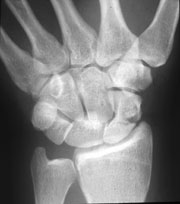 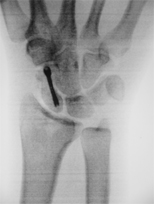 RESULTS Acute fracture fixation success rate is 95%. Success rate for non-union of the scaphoid is 75% in many hands. COMPLICATIONS

|

|
