| Home | : | Biography | : | Fellowships & Awards | : | Publications | : | : | Mediation | : | Useful Links | : | Contact |
 The scaphoid is a boat shaped bone that lies on the thumb side of the wrist. It is one of the eight carpal bones. The eight carpal bones lie in two rows, a proximal row which is nearer the arm and a distal row which is nearest the hand. The scaphoid is the only bone that traverses these two rows and as it does so acts as a strut to keep the two rows apart. If it breaks the two rows of carpal bones tend to become closer together (so called carpal collapse). When this happen wrist arthritis is an inevitable consequence. Because of the fact this bone traverses the two rows and acts as a strut this is probably why this bone is the most commonly fractured of all the carpal bones. It generally occurs from a fall on an outstretched hand and quite commonly occurs when the patient is falling backwards. It is proven that it is more likely that the scaphoid will break if patients fall on the wrist if it is more than 90° bent backwards whereas if the wrist is bent 50 - 70° backwards in a fall (as one would do when one falls forward) then one is more likely to break the distal radius. It is a difficult bone for varying reasons:
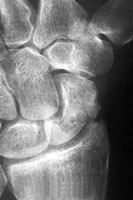 Diagnosis The diagnosis of this type of fracture is difficult. Often they are not seen on X-ray and it is true to say that even Consultant Hand Surgeons may miss these in 20% of cases. The history is generally a fall on an outstretched hand. It occurs in young fit males more predominantly. There is tenderness on the thumb side of the wrist at the bottom of the thumb and there is a little gap here called the anatomical snuffbox (so called because this is where snuff was put before it was sniffed!). Classically scaphoid fractures are very tender when pressed here. Often patients get pain when they try and use a power grip and when using a power pinch grip. It is fairly common practice for patients who come in to Casualty with a suspected scaphoid fracture to be put in a plaster cast for two weeks and then to be sent round to the orthopaedic clinic where the wrist is further X-rayed. Sometimes it is easier to see the fracture at two weeks on the X-ray. However unfortunately sometimes it is not! And therefore a more common practice in Mr Field's clinic is to get an MRI or CT scan within the first two weeks after the injury to confirm the diagnosis. If the diagnosis is made then further treatment can be decided upon. As mentioned earlier there is a tendency to fix these fractures by an operation, the advantage being that it tends to reduce the time in plaster. There has been a recent study by the Leicester group of Hand Surgeons saying that the healing is better and quicker if operative fixation has been used, however patients did not get back to work quicker. Scaphoid's were fixed using an open approach which involves a small 5 cm incision on the front of the wrist and the fracture was opened and a screw put in it having seen the fracture and how the fracture is reduced (pieces put back together). 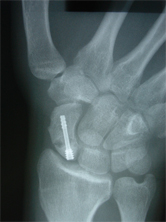 We are now performing fixation of these fracture percutaneously (through a small stab incision on the front or the back of the wrist) which involves less complications and is much easier to carry out and the post operative regime is easier for the patient. If the operation is done this was it can be carried out using a regional or general anaesthetic (see anaesthetics). An X-ray machine has to be present in theatre and if the fracture is of the waist of the scaphoid then the stab incision is at the front of the wrist directly over a lump that you can feel over your wrist which is called the scaphoid tubercle (if you look at the front (palm side) of your wrist there are three creases the crease nearest the hand if you follow it from the little finger side two thirds of the way across you come to a bony prominence and that is the scaphoid tubercle and that is where the stab incision is made). A wire is passed across the fracture and positioned accurately in a correct manner and over that wire a screw is passed and the wound is sutured up and the hand wrapped in a bandage for a couple of days and then the patient can mobilise i.e. negating the need for plaster for 3 months. The screw used is very clever. It was first described by a gentleman called Tim Herbert and is thus known as a Herbert Screw. As the bone is almost completely covered in cartilage any fixation device cannot protrude through the cartilage. So this screw buries itself completely inside the bone. It has two screw threads separated by a small smooth shank. The two threads at each end have differing pitches and this means that as the screw is tightened each end of the fracture has one of the screw threads in it and the two ends of the fracture are forced together.  The scaphoid has a tendency not to unite because it has an odd blood supply. It is not uncommon for patients to fall on their outstretched hand and think they have sprained their wrist. It gets a little better but they get niggling pains over a year or longer which are not painful but every time they jar the wrist they get pain. They may also notice that the wrist doesn't bend back as much as it used to. At some stage it starts to hurt more and the wrist is X-rayed and a scaphoid non-union is found where the scaphoid has actually broken and hasn't joined up. The inevitable consequence of a scaphoid non-union on the wrist is that the scaphoid itself shortens because it has a fracture in the middle of it that hasn't joined (therefore the strut effect that this bone has of keeping the two rows of carpal bones apart is lost). This leads to what we call carpal collapse and it is an inevitable consequence of a scaphoid non-union that wrist arthritis will occur probably within 10 years. It is for this reason that we tend to operate on scaphoid non-unions in order to get the scaphoid to join and reconstitute the strut between the two rows of carpal bones. The only way of doing this is by operating on it and one needs to take out the bit of the bone that hasn't joined (that involves trimming the ends of the fracture) and inserting into the gap that is left a piece of bone graft. The bone graft is generally taken from the patients hip region in fact it is not the hip joint itself it is the part of the pelvis where your trousers hang. 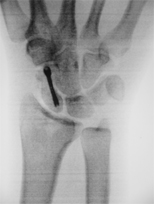 If the fall on the outstretched hand does not fracture the scaphoid and there is still significant pain and swelling, probably the most common cause of this is the rupture of the ligament between two of the carpal bones one called the scaphoid and one called the lunate. This ligament is called the scapholunate ligament. This is a very important ligament in the wrist and stabilises the proximal row of carpal bones. It is compared to the cruciate ligaments in a knee, the cruciate ligaments stabilise the knee and if these are ruptured the knee becomes unstable. If the scapholunate ligament is ruptured the wrist becomes unstable. What happens is that the scaphoid tends to move into a flexed position and therefore the gap the bone occupies shortens, when the scaphoid gap shortens the strut that holds the two rows of bones apart also shortens. When this happens there is carpal collapse and arthritis is an inevitable consequence. Damage of this ligament is often not picked up acutely i.e. not picked up straight away. People fall over and think they have broken their wrist and the doctors may even think they have broken their scaphoid but cannot find a break in the scaphoid and therefore the patient is sent away for some physiotherapy but the pain doesn't go away. Patients often complain of pain more on the dorsal (back) of the wrist. The examiner can also move the scaphoid and cause a painful clunk on the back of the wrist (Kirk Watson test) which is indicative of scapholunate ligament injury. The wrist is often X-rayed and sometimes there is little to find but if it is a significant rupture then there is an increased gap between the scaphoid and lunate seen on the x-ray which is known as Terry Thomas' sign (an actor in the 1960's "Carry On films" who had a gap in between his two front teeth). The Terry Thomas sign is seen in the figure below. The diagnosis of this condition is difficult and it is necessary to look inside the wrist with a telescope (wrist arthroscopy see operation note) to determine what the diagnosis is. If the ligament has ruptured acutely then it is sensible to repair it. If the ligament has been pulled off one of the bones i.e. scaphoid or lunate, then it can be re-attached and the positions of the bones held for 6 - 8 weeks with pins and a plaster cast. If the injury is older than 3 months then generally a scapholunate ligament repair is performed by doing a tendon transfer using one of the tendons on front of the wrist or part of it and passing it through the scaphoid and back onto the lunate to act as a substitute scapholunate ligament and is further described under operations section. |

|