: : : : : : :  
Unstable phalangeal fractures

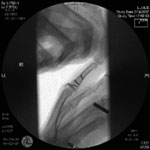
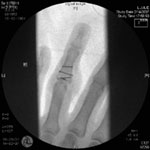
Phalangeal fractures tend to displace the opposite way to metacarpal fracture i.e. they tend to displace dorsally (toward the back of the hand) dorsally which means the knuckle after the fracture tends to point towards the back of the hand. This is because some muscles called the interossei that pull the fragment nearest the hand into flexion.

ANAESTHETIC

General or regional anaesthetic.

OPERATIVE PROCEDURE

Generally an elliptical longitudinal incision is made and the skin flaps are raised and a central incision is made in the extensor tendon. The tendon is then reflected and the fracture identified. Again the ends of the fracture are cleaned leaving as much periosteum (membrane covering the bone) as possible intact. Once the fracture ends have been cleaned then they can be reduced (realigned and put together) and these tend to be held with a clamp of some sort and then some form of internal fixation is applied.

There are three type of fixation that can be used:
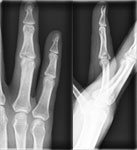
  1. Intermedullary wires - very much like the metacarpal fractures these bones are tube like and have a marrow cavity in which it is possible to pass an intermedullary wire. This is easier for the proximal phalanx but more difficult for the middle phalanx because of its accessability. The distal phalanx can also be wired.
  2. Simple screws - it is feasible to just put simple screws in as this is a technique that Mr Field likes to use as it minimises the metal work and minimized the chance of the tendons sticking to the metal work.

  1. Plate fixation - again a small plate is tended to be used and put over the back of the bone and perhaps two screws used on either side of the fracture site itself. The extensor tendon is then repaired and the skin is sewn up.
POST OPERATIVELY

Antibiotics are given. A volar slab in the Edinburgh position (position of function) is used for a period of two weeks. Expect to take 2 - 4 weeks off work.

COMPLICATIONS

  1. Infection. The operation has a chance of infection but if metal work is inserted into the wound then the infection rate rises. Although infection rate in the hand is small probably less than 1%.
  2. Tendon adhesions. Which means that the fingers may end up a little stiff and sometimes the joints will not completely move because the tendons are stuck and this may warrant further surgery in the form of a tenolysis (which is an operation to free the tendons).
  3. Metal work removal. If a plate is inserted it doesn't have to be removed but if it causes trouble or becomes very subcutaneous and the patient knocks it they become painful and the patient may want it removed.
  4. Complex regional pain syndrome. A rare complication.